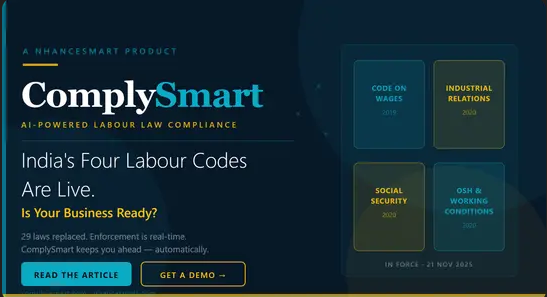
29 laws replaced overnight. One missed deadline could mean prosecution.
The Ministry of Labour made it official on 21 November 2025 all Four Labour Codes are now enforceable law. Twenty-nine central acts, some dating to the 1920s, wiped off the books in a single notification. The transition window has closed. What follows is not a grace period. It is enforcement.
For HR teams and business leaders, the question is no longer “when do we need to comply?” It is “where are we exposed right now?”
The Four Changes Hitting You Today
The 50% Wages Rule is the most disruptive shift for payroll. The Code on Wages redefines “wages” so that non-wage allowances HRA, conveyance, special allowance cannot exceed 50% of total CTC. If they do, the excess is automatically treated as wages, inflating PF, gratuity, bonus, and leave encashment liabilities. Most Indian companies kept basic pay at 20–30% of CTC to reduce PF outflow. That structure is now non-compliant and the cost impact of restructuring ranges from 5% to 12% of payroll.
Gratuity after one year, not five, for fixed-term employees. As fixed-term hiring grows, provisioning gaps are accumulating quietly.
Full and final settlement in 48 hours. Every rupee owed to an exiting employee PF, gratuity, leave encashment must be settled within two working days of separation. Organisations with multi-step manual F&F processes are already in breach.
Gig and platform workers now have social security rights. Aggregators must register workers on the centralised portal and make contributions. The compliance net has expanded far beyond the organised workforce.
The Hidden Complexity: It Differs by State
Labour is a Concurrent List subject. While the central government has notified all four Codes, each state must publish its own rules for full enforceability. Over 30 states have notified rules for at least one Code but the obligations differ significantly by state.
A company operating across five states is navigating five different compliance realities simultaneously. Miss one state-level notification, apply the wrong wage slab, file the wrong form and a digital inspection triggered by the Shram Suvidha portal could flag your organisation before a human inspector ever shows up.
What ComplySmart AI Does About All of This
ComplySmart Nhancesmart’s AI-powered compliance platform was purpose-built for exactly this kind of complexity.
State notification tracking in real time. The moment a state government publishes new rules or minimum wage revisions, ComplySmart updates your compliance calendar automatically. No manual monitoring. No missed notifications.
Wage structure audit. ComplySmart analyses every CTC against the 50% wages rule, flags non-compliant structures, and calculates the exact statutory cost impact before an inspector does.
Contract worker registry. ComplySmart tracks your platform and contract worker engagements, flags registration obligations under the Social Security Code, and monitors contribution timelines.
AI-powered risk dashboard. A single screen shows your compliance health across every entity and state with priority-ranked gaps, upcoming deadlines, and real-time alerts for legislative changes.
Smart document engine. Statutory registers, returns, and notices are auto-populated from your HRMS and payroll data. Audit-ready, always.
The Bottom Line
The Four Labour Codes are not a future problem. They are today’s obligation enforced digitally, monitored algorithmically, and penalised at scale.
Organisations that restructure their payroll, automate their compliance workflows, and track state-level notifications in real time will move through this transition with confidence. Those that don’t will meet it under pressure.
ComplySmart turns Four Labour Code complexity into a dashboard you can manage before breakfast.Ready to see ComplySmart AI in action? Visit comply-smart.com to book a demo tailored to your industry and states of operation.