Statutory Compliance Requirements for Businesses India – A Complete Guide to Legal and Regulatory Compliance
Running a business in India involves more than managing daily operations, hiring employees, and generating revenue. Every organization must follow various statutory and regulatory requirements to operate legally, maintain transparency, and avoid compliance-related risks.
From company registrations and tax filings to labour law compliance, employee benefits, payroll obligations, statutory documentation, and industry-specific licenses, businesses must manage multiple legal responsibilities throughout the year.
For organizations operating across different states, these requirements can become even more complicated because certain regulations and filing obligations vary according to location, business activities, employee strength, and establishment category.
Many businesses still depend on spreadsheets, manual reminders, emails, and separate documentation systems to track their statutory obligations. As operations expand, these traditional methods can increase administrative workload and the possibility of missed deadlines.
This is why organizations are increasingly adopting structured compliance management systems and professional statutory compliance services to simplify regulatory activities.
At NhanceSmart, we combine compliance expertise with advanced AI-powered technology to help businesses manage their statutory responsibilities more efficiently. Our dedicated platform, Complysmart, supports regulatory intelligence, compliance monitoring, risk assessment, and statutory documentation management across India.
Understanding statutory compliance requirements is essential for every business, whether it is a startup, small enterprise, manufacturing company, or large corporate organization.
What Are Statutory Compliance Requirements for Businesses in India?
Statutory compliance refers to the legal obligations that businesses must follow under applicable central, state, and local laws and regulations.
These requirements are designed to ensure that organizations operate within the legal framework, fulfil their financial responsibilities, protect employee rights, maintain accurate records, and follow industry-specific standards.
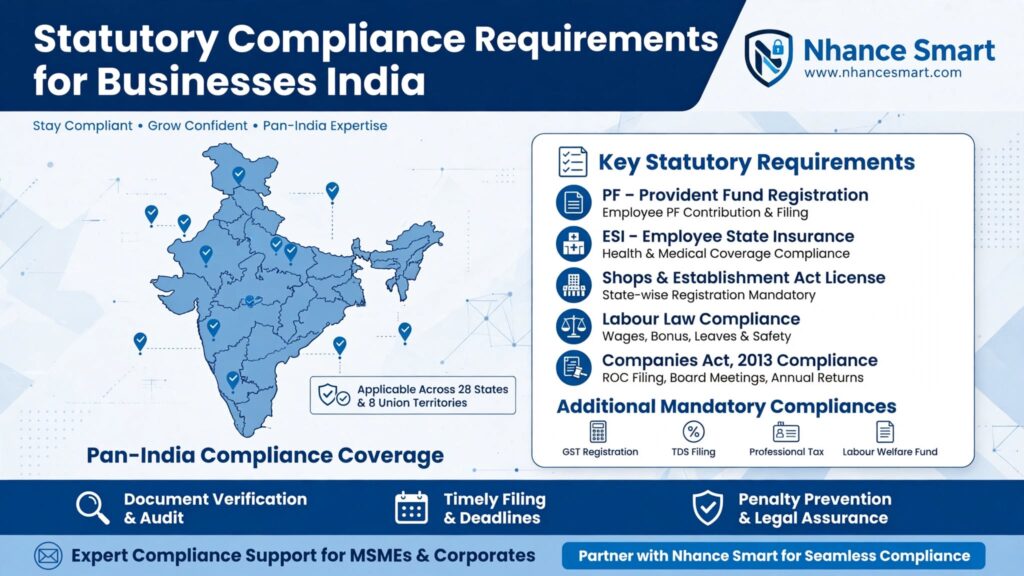
Depending on the business structure and operations, statutory compliance may include:
- Company incorporation and annual ROC filings.
- Income tax and corporate tax compliance.
- GST registration and return filing.
- TDS deductions and deposits.
- Employees’ Provident Fund (EPF) compliance.
- Employees’ State Insurance (ESI) compliance.
- Professional Tax compliance.
- Labour law compliance.
- Minimum wage and employee payment requirements.
- Statutory registers and documentation.
- Factory and workplace safety compliance.
- Environmental registrations and approvals.
- Industry-specific licenses and certifications.
Not every requirement applies to every business. Applicability depends on factors such as the type of entity, annual turnover, number of employees, industry, geographical location, and nature of business activities.
Why Businesses in India Need a Strong Statutory Compliance Framework
Managing statutory compliance is an ongoing responsibility. Businesses must continuously monitor regulatory updates, maintain records, complete filings, and ensure that applicable obligations are fulfilled within prescribed timelines.
Here are some important reasons why organizations need a structured compliance management framework.
1. Managing Multiple Legal Requirements
Indian businesses operate under different central, state, and local regulations.
Managing company law, taxation, employment regulations, payroll obligations, and industry-specific requirements simultaneously can become complicated.
A centralized compliance framework helps businesses organize their responsibilities and monitor important statutory activities.
2. Avoiding Penalties and Legal Risks
Failure to complete applicable statutory filings, payments, registrations, or documentation can result in penalties, interest, notices, and other legal consequences.
Regular compliance monitoring helps businesses identify potential gaps and take corrective action before issues become more serious.
3. Maintaining Accurate Employee and Financial Records
Businesses must maintain appropriate employee, payroll, financial, and statutory records according to applicable laws.
Structured documentation helps improve transparency and makes it easier to respond to audits, inspections, and regulatory inquiries.
4. Managing Regulatory Changes
Government regulations and statutory requirements can change through notifications, amendments, circulars, and new rules.
Businesses need a reliable process to identify relevant updates and understand how they affect existing operations.
5. Supporting Business Expansion
As businesses expand into additional states, establish factories, hire more employees, or engage contractors, their compliance responsibilities may increase.
A scalable compliance framework helps organizations manage these additional obligations without depending entirely on manual processes.
6. Improving Corporate Governance
Following statutory requirements demonstrates that an organization takes legal responsibilities, employee welfare, financial transparency, and business governance seriously.
It also supports stronger internal controls and more reliable business operations.
Major Statutory Compliance Requirements for Businesses in India
Indian businesses may need to follow different statutory requirements depending on their organizational structure and activities.
Below are some important compliance areas that organizations should evaluate.
1. Company Registration and ROC Compliance
Businesses incorporated as private limited companies, public limited companies, and other applicable corporate entities must follow relevant provisions of the Companies Act, 2013.
Important corporate compliance activities may include:
- Maintaining statutory registers.
- Conducting board meetings.
- Holding annual general meetings where applicable.
- Preparing financial statements.
- Filing annual returns.
- Filing financial statements with the Registrar of Companies.
- Maintaining director-related records.
- Reporting applicable changes in company information.
- Maintaining statutory books and records.
Organizations should ensure that applicable ROC filings and corporate documentation are completed within prescribed timelines.
2. Goods and Services Tax (GST) Compliance
GST compliance is an important responsibility for businesses involved in taxable supplies of goods and services.
Depending on the nature of operations and applicable registration requirements, businesses may need to manage:
- GST registration.
- Tax invoice preparation.
- GSTR-1 filing.
- GSTR-3B filing.
- Input Tax Credit reconciliation.
- E-invoicing, wherever applicable.
- E-way bill requirements, wherever applicable.
- GST payment and reconciliation.
- Annual returns, where applicable.
Regular GST monitoring helps businesses maintain accurate tax records and reduce filing-related discrepancies.
3. Income Tax and TDS Compliance
Businesses must fulfil applicable income tax responsibilities under the relevant tax laws.
Important activities may include:
- Corporate income tax calculations.
- Advance tax payments.
- Tax Deducted at Source (TDS).
- TDS deposit and return filing.
- Form 16 and Form 16A issuance, where applicable.
- Tax audit requirements, wherever applicable.
- Maintaining financial and tax records.
- Filing applicable income tax returns.
Organizations should maintain proper financial documentation and review tax obligations regularly.
4. Employees’ Provident Fund (EPF) Compliance
EPF is an important employee social security compliance requirement for establishments covered under the applicable provisions.
Businesses must evaluate their applicability and manage relevant responsibilities, including:
- EPF establishment registration.
- Employee onboarding and UAN-related records.
- Employer and employee contribution calculations.
- Monthly contribution payments.
- Electronic return-related requirements.
- Employee exit documentation.
- Maintaining applicable PF records.
Proper EPF management helps organizations fulfil their employee social security responsibilities.
5. Employees’ State Insurance (ESI) Compliance
ESI provides social security benefits to eligible employees working in covered establishments.
Applicable compliance activities may include:
- ESI establishment registration.
- Employee insurance registration.
- Contribution calculations.
- Employer and employee contribution payments.
- Employee information management.
- Maintaining supporting records.
- Managing applicable statutory documentation.
Businesses should evaluate ESI applicability based on the current legal framework, establishment category, employee coverage, and applicable wage conditions.
6. Professional Tax Compliance
Professional Tax is a state-level tax applicable in states that levy it.
Employers operating in applicable states may need to manage:
- Professional Tax registration.
- Employee salary-based deductions.
- Monthly or periodic payments.
- Applicable return filing.
- Employee deduction records.
- Employer registration and renewal requirements, where applicable.
Businesses operating across multiple states should review state-specific Professional Tax requirements.
7. Labour Law Compliance
Labour law compliance is one of the most important responsibilities for organizations employing workers.
Businesses must follow applicable requirements relating to wages, working conditions, social security, employee welfare, workplace safety, and employment relationships.
India implemented four Labour Codes with effect from 21 November 2025, consolidating and rationalizing several central labour laws.
The four Labour Codes include:
- Code on Wages, 2019.
- Industrial Relations Code, 2020.
- Code on Social Security, 2020.
- Occupational Safety, Health and Working Conditions Code, 2020.
Businesses should assess their obligations under the applicable provisions, rules, notifications, and state-specific requirements.
Important compliance areas include:
- Minimum wages and wage payments.
- Employee social security.
- Working hours and leave requirements.
- Gratuity and applicable employee benefits.
- Maternity benefits.
- Industrial relations.
- Workplace health and safety.
- Contract labour compliance.
- Employee records and statutory documentation.
8. Shops and Commercial Establishments Compliance
Businesses operating from commercial establishments may need to comply with the applicable state Shops and Commercial Establishments legislation.
Requirements may cover:
- Establishment registration.
- Registration renewals or amendments, where applicable.
- Employee working hours.
- Weekly holidays.
- Leave records.
- Employee registers.
- Workplace conditions.
- Applicable statutory notices.
The specific requirements vary according to the state and establishment category.
9. Contract Labour Compliance
Organizations engaging third-party manpower or contractors must evaluate applicable contract labour requirements.
Important compliance areas may include:
- Contractor registration and licensing, wherever applicable.
- Principal employer obligations.
- Contractor employee records.
- Wage payment documentation.
- PF and ESI contribution records.
- Applicable statutory challans.
- Contractor license validity.
- Employee deployment information.
Regular contractor compliance reviews help businesses improve visibility into outsourced workforce management.
10. Factory and Workplace Safety Compliance
Manufacturing businesses and other covered establishments may have additional statutory responsibilities relating to workplace safety and employee welfare.
Depending on the applicable legal framework, organizations may need to manage:
- Factory or establishment registrations.
- Applicable licenses and approvals.
- Workplace safety procedures.
- Employee health and welfare requirements.
- Accident reporting.
- Safety equipment documentation.
- Inspection records.
- Applicable statutory returns.
Businesses should evaluate their requirements under the applicable occupational safety and working conditions legislation and relevant rules.
11. POSH Compliance
Organizations must also evaluate their responsibilities under the applicable law concerning prevention of sexual harassment at the workplace.
Important compliance activities may include:
- Establishing an Internal Committee where legally required.
- Developing workplace policies.
- Communicating employee awareness.
- Conducting awareness and training activities.
- Maintaining applicable records.
- Completing required annual reporting.
A proper workplace compliance framework supports employee safety and organizational accountability.
12. Industry-Specific Licenses and Environmental Compliance
Certain industries have additional statutory requirements depending on their business activities.
Examples include:
- FSSAI registration or licensing for applicable food businesses.
- Import Export Code for eligible import and export activities.
- Pollution Control Board consents for regulated industrial activities.
- Fire safety approvals, wherever required.
- Factory-related permissions.
- Environmental clearances for specified projects.
- Other sector-specific licenses and registrations.
Businesses should identify all applicable licenses and track their validity, renewal requirements, and related conditions.
Statutory Compliance Checklist for Businesses in India
Maintaining a compliance checklist helps organizations organize their responsibilities and identify pending activities.
Here is a practical overview of important compliance areas.
| Compliance Category | Important Activities |
| Corporate Compliance | ROC filings, annual returns, statutory registers |
| GST Compliance | Registration, returns, tax payments, reconciliation |
| Income Tax Compliance | Tax returns, advance tax, TDS |
| EPF Compliance | Employee records, contributions, applicable returns |
| ESI Compliance | Employee registration, contributions, records |
| Professional Tax | Registration, deductions, payments, returns |
| Labour Law Compliance | Wage requirements, employee welfare, statutory records |
| Contract Labour | Contractor documents, licenses, wage and contribution records |
| Factory Compliance | Registrations, safety records, applicable inspections |
| POSH Compliance | Workplace policies, Internal Committee, applicable reporting |
| Environmental Compliance | Consents, approvals, renewals, statutory conditions |
| Industry-Specific Compliance | Sector-related licenses and regulatory approvals |
This checklist provides a general overview. Businesses should prepare an organization-specific compliance calendar based on actual applicability.
How Statutory Compliance Requirements Differ Across Businesses
Not every organization has the same compliance responsibilities. Requirements vary according to industry, workforce size, business structure, and operational locations.
Here is how different businesses may approach statutory compliance.
Startups and Small Businesses
Startups generally operate with limited HR, finance, and administrative resources.
They may need support with business registrations, applicable labour laws, payroll compliance, employee documentation, GST, TDS, and statutory filing requirements.
A structured compliance system helps startups establish the right processes from the beginning.
Manufacturing and Factory Businesses
Manufacturing companies may have additional requirements related to workplace safety, factory operations, employee welfare, contractor management, environmental regulations, and statutory documentation.
Regular compliance monitoring helps manufacturing businesses maintain better control over their operational responsibilities.
IT and Corporate Organizations
IT companies and corporate offices often manage employees across multiple locations.
Their compliance responsibilities may include payroll, employee benefits, professional tax, establishment registration, statutory documentation, and state-specific labour law requirements.
Large Enterprises
Large organizations may operate multiple business units, factories, offices, and branches across India.
Managing different statutory obligations manually can become difficult.
Centralized compliance management helps management monitor location-wise obligations, deadlines, documentation, and compliance risks.
Businesses Working with Contractors
Organizations engaging outsourced manpower need visibility into contractor registrations, licenses, employee records, wage payments, and applicable social security contributions.
A structured vendor compliance management process helps identify potential gaps and improve accountability.
How AI-Powered Compliance Software Helps Businesses Manage Statutory Requirements
Traditional compliance management often relies on manual research, spreadsheets, emails, and individual follow-ups.
As compliance responsibilities increase, organizations need technology that can simplify repetitive activities and improve regulatory visibility.
AI-powered statutory compliance software can support businesses through:
- Automated compliance tracking.
- Regulatory change monitoring.
- Labour law applicability mapping.
- Compliance calendar management.
- Statutory register preparation.
- Document verification and analysis.
- PF and ESI compliance monitoring.
- Contractor compliance tracking.
- Compliance risk assessment.
- Audit preparation and reporting.
- Centralized compliance dashboards.
- Compliance gap identification.
These capabilities help businesses move from reactive compliance management towards a more organized and proactive approach.
How NhanceSmart’s Complysmart Simplifies Statutory Compliance Management
At NhanceSmart, we understand that businesses need more than basic compliance reminders.
Organizations require a structured platform that helps identify applicable requirements, monitor regulatory changes, organize statutory records, and track compliance activities.
Complysmart is NhanceSmart’s AI-powered labour law compliance management platform, designed to support organizations operating across India’s regulatory environment.
The platform combines regulatory intelligence, compliance automation, documentation intelligence, and risk monitoring to help businesses manage their statutory responsibilities more effectively.
Six AI Engines for Smarter Compliance Management
Complysmart uses six specialized AI engines to support different compliance activities.
1. Regulatory Intelligence Engine
Monitors regulatory notifications, amendments, and government circulars to identify changes that may affect business compliance requirements.
2. AI Compliance Assistant
Helps users ask labour law-related questions in simple language and receive relevant compliance guidance based on their business requirements.
3. Risk Scoring Engine
Assesses compliance risks across business entities, locations, vendors, and contractors to help management identify areas requiring attention.
4. Documentation Intelligence
Reviews compliance documents and helps identify missing information, outdated templates, and incomplete statutory documentation.
5. Compliance Gap Analyser
Compares applicable compliance requirements with available records to highlight potential gaps, compliance exposure, and recommended corrective actions.
6. Labour Code Audit Engine
Helps organizations assess readiness for India’s four Labour Codes and identify areas where existing compliance processes may require updates.
Automated Statutory Register Preparation
Maintaining statutory registers manually can consume significant administrative time.
Complysmart helps businesses identify applicable labour laws and prepare relevant statutory registers based on their industry, establishment locations, and workforce information.
This supports more organized documentation management and reduces repetitive manual activities.
Real-Time Compliance Monitoring
The platform converts compliance obligations into tasks with assigned responsibilities and deadlines.
Businesses can monitor:
- Completed compliance activities.
- Pending statutory obligations.
- Overdue tasks.
- Upcoming deadlines.
- Location-wise compliance status.
- Compliance risks.
- Regulatory updates.
This improves compliance visibility and helps teams prioritize important activities.
Multi-State Compliance Management
Businesses operating across India must consider central and state-specific regulatory requirements.
Complysmart supports regulatory intelligence and compliance management across 36 states and union territories, helping organizations monitor applicable location-specific compliance variations through a centralized platform.
Contractor and Vendor Compliance Monitoring
Complysmart supports contractor compliance reviews by helping organizations monitor applicable licenses, PF and ESI challans, wage records, and other statutory documents.
This improves visibility into vendor compliance and helps businesses identify potential documentation gaps.
Explore the platform: https://www.nhancesmart.com/complysmart
Traditional Compliance Management vs AI-Powered Statutory Compliance
Traditional compliance management methods can become difficult to maintain as organizations grow.
AI-powered compliance platforms provide a more centralized and technology-driven approach.
| Traditional Compliance Management | AI-Powered Compliance Management |
| Manual regulatory research | AI-supported regulatory intelligence |
| Spreadsheet-based tracking | Centralized compliance dashboard |
| Manual deadline reminders | Automated task and alert management |
| Repetitive register preparation | Automated register preparation support |
| Manual document verification | AI-powered documentation intelligence |
| Reactive compliance reviews | Proactive risk monitoring |
| Separate contractor records | Centralized contractor monitoring |
| Manual gap identification | AI-supported compliance gap analysis |
| Disconnected compliance information | Centralized compliance visibility |
The right technology helps compliance teams spend less time on repetitive administrative work and more time reviewing risks, implementing corrective actions, and improving business governance.
Benefits of Managing Statutory Compliance Through a Centralized System
Adopting a structured compliance management approach offers several operational advantages.
1. Better Regulatory Awareness
Businesses can monitor relevant legal updates and understand how regulatory changes may affect their existing compliance responsibilities.
2. Reduced Administrative Workload
Digital workflows and organized documentation help reduce repetitive manual activities and unnecessary follow-ups.
3. Improved Compliance Accuracy
Structured processes and document validation can help reduce tracking inconsistencies and documentation errors.
4. Better Risk Management
Compliance risk assessment and gap analysis help management identify potential issues and prioritize corrective actions.
5. Improved Audit Readiness
Centralized compliance records make it easier to prepare for internal audits, statutory reviews, and applicable inspections.
6. Stronger Employee Compliance Management
Connecting employee information with statutory compliance activities helps organizations improve workforce documentation and social security management.
7. Scalable Compliance Operations
Digital compliance platforms can support businesses as they expand into additional locations, industries, and workforce categories.
8. Improved Management Visibility
Centralized dashboards provide management with a clearer view of completed, pending, and overdue compliance activities.
How to Build an Effective Statutory Compliance Management Framework
Businesses should follow a systematic approach to identify, organize, and monitor their legal obligations.
Here are some important steps.
Step 1: Identify Applicable Laws
Review your business structure, industry, employee strength, geographical locations, and operational activities to identify applicable central, state, and local regulations.
Step 2: Complete Required Registrations
Identify mandatory registrations, licenses, approvals, and renewals applicable to your business.
Step 3: Prepare a Compliance Calendar
Create a centralized calendar containing statutory payment dates, filing deadlines, renewals, inspections, and other important activities.
Step 4: Organize Statutory Documentation
Maintain employee records, payroll information, financial documents, statutory registers, licenses, and supporting compliance records.
Step 5: Assign Compliance Responsibilities
Allocate responsibilities to relevant HR, finance, legal, and compliance teams to improve accountability.
Step 6: Monitor Regulatory Updates
Regularly review government notifications, amendments, and applicable regulatory changes.
Step 7: Conduct Periodic Compliance Audits
Review existing compliance activities to identify missing documents, overdue obligations, incorrect records, and potential statutory gaps.
Step 8: Adopt Digital Compliance Technology
Use a centralized compliance management platform to simplify tracking, documentation, risk monitoring, and reporting.
Why Choose NhanceSmart for Statutory Compliance Management in India
NhanceSmart brings together compliance expertise, labour law advisory, and proprietary AI-powered technology to help businesses manage their statutory responsibilities.
Our approach focuses on combining professional compliance support with digital tools that improve visibility and simplify routine activities.
Businesses working with NhanceSmart can benefit from:
- Labour law compliance management.
- Statutory compliance assessments.
- Regulatory intelligence across Indian states.
- Centralized compliance dashboards.
- Automated statutory register preparation.
- Statutory deadline monitoring.
- PF and ESI compliance support.
- Payroll compliance management.
- Contractor and vendor compliance monitoring.
- AI-powered compliance risk assessment.
- Documentation intelligence.
- Compliance gap analysis.
- Labour law advisory.
- Employer and vendor compliance audits.
- Factory compliance management.
- HR operations support.
Our objective is to help organizations reduce manual compliance efforts, improve regulatory visibility, and establish a more reliable compliance management framework.
Frequently Asked Questions About Statutory Compliance Requirements for Businesses in India
1. What are statutory compliance requirements for businesses in India?
Statutory compliance requirements are the legal obligations businesses must follow under applicable central, state, and local laws. These may include company filings, GST, income tax, TDS, PF, ESI, labour laws, employee documentation, and industry-specific licenses.
2. Is statutory compliance mandatory for every business in India?
Businesses must follow the laws applicable to their organizational structure and activities. However, individual registrations, filings, and statutory requirements depend on factors such as business type, turnover, employee strength, industry, and location.
3. What are the major statutory compliance requirements for companies?
Major compliance areas may include ROC filings, GST returns, income tax, TDS, EPF, ESI, Professional Tax, labour law compliance, statutory registers, and applicable industry-specific licenses.
4. What happens if a business fails to meet statutory compliance requirements?
Non-compliance may result in financial penalties, interest, legal notices, regulatory action, additional documentation requirements, and other consequences depending on the applicable law and nature of the violation.
5. Are statutory compliance requirements different across Indian states?
Yes. Some compliance obligations are governed by central laws, while others depend on state-specific legislation, rules, notifications, and local requirements. Businesses operating across multiple states should assess their obligations separately for each location.
6. What is the difference between statutory compliance and regulatory compliance?
Statutory compliance generally refers to fulfilling obligations prescribed by applicable legislation. Regulatory compliance is a broader term that includes following requirements, rules, standards, directions, and conditions imposed by relevant regulatory authorities.
7. How can businesses manage statutory compliance efficiently?
Businesses can improve compliance management through applicability assessments, centralized compliance calendars, proper documentation, periodic audits, regulatory monitoring, professional advisory, and digital compliance management platforms.
8. How does Complysmart help businesses manage statutory compliance?
Complysmart combines six specialized AI engines, regulatory intelligence, statutory register preparation, document intelligence, compliance risk scoring, and gap analysis to support organizations in managing labour law compliance more systematically.
9. Can AI-powered compliance software replace compliance professionals?
No. AI-powered software supports regulatory monitoring, documentation, risk identification, and administrative workflows. Professional expertise and human judgment remain important for legal interpretation, complex compliance matters, and corrective actions.