Labour Law Compliance Checklist Karnataka – Essential Requirements Every Business Must Follow
Running a business in Karnataka involves more than managing employees, processing salaries, and achieving business targets. Employers must also follow various labour laws, statutory regulations, employee welfare requirements, and workplace compliance obligations.
Whether you operate a startup, small business, manufacturing unit, corporate office, or growing enterprise, maintaining proper labour law compliance is essential for smooth business operations.
However, many organizations struggle to identify which registrations are required, what employee records must be maintained, when statutory payments are due, and how to prepare for labour inspections.
A well-structured Labour Law Compliance Checklist Karnataka helps businesses identify their responsibilities, avoid missed deadlines, maintain proper documentation, and reduce legal and financial risks.
At NhanceSmart, we help businesses simplify labour law compliance through expert advisory, statutory compliance management, and AI-powered platforms. Our solutions, including Complysmart and Attendenz, support organizations in improving regulatory visibility and workforce governance.
Why Every Business Needs a Labour Law Compliance Checklist in Karnataka
Labour law compliance is a continuous responsibility. Businesses must regularly review their employee records, registrations, payroll activities, statutory payments, and workplace policies.
Without a proper compliance checklist, even established organizations can overlook important legal requirements.
Here are some reasons why maintaining a labour law compliance checklist is important.
Avoid Legal Penalties
Missing statutory payments, registrations, or required documentation can expose businesses to penalties, notices, and legal complications. A structured checklist helps identify compliance gaps before they become serious problems.
Stay Updated with Changing Labour Laws
Indian labour regulations continue to evolve. Businesses must understand applicable requirements under the four Labour Codes and relevant Karnataka state regulations.
Maintain Accurate Employee Records
Proper employee documentation, attendance records, wage details, leave records, and statutory registers help businesses maintain transparency and prepare for inspections.
Improve Payroll and HR Management
Payroll, employee benefits, statutory deductions, and labour law compliance are closely connected. Regular compliance reviews help reduce administrative errors.
Support Business Expansion
As businesses hire more employees or expand into multiple locations, their compliance responsibilities may increase. A proper checklist creates a reliable foundation for business growth.
Labour Law Compliance Checklist Karnataka – Essential Requirements
Every business should review its applicable labour law requirements based on employee strength, industry, establishment type, and business activities.
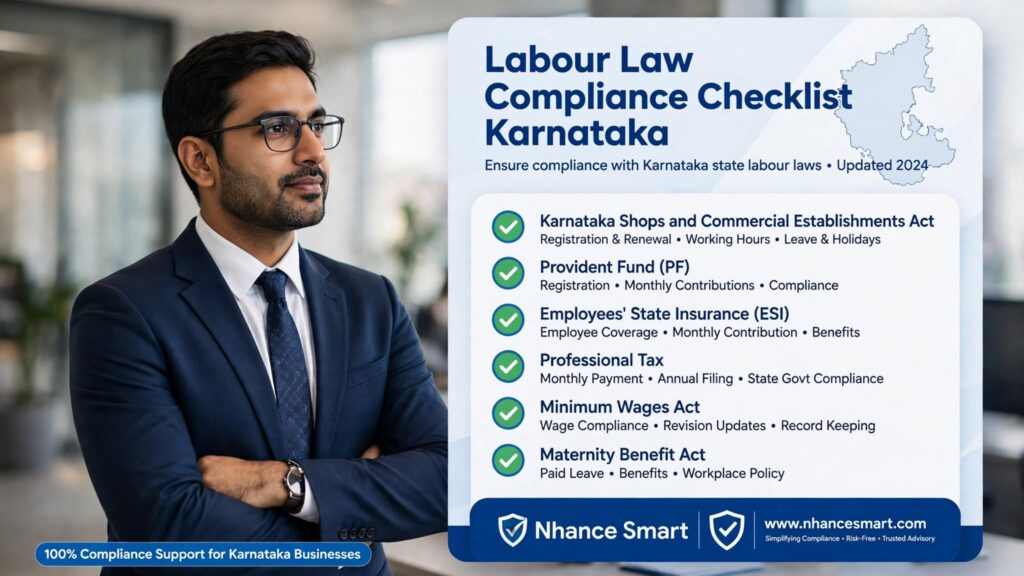
The following checklist covers important compliance areas that Karnataka employers should review.
1. Shops and Commercial Establishment Registration
Businesses operating offices, retail outlets, commercial establishments, and other covered workplaces should review their registration requirements under the Karnataka Shops and Commercial Establishments framework.
Checklist:
Verify whether Shops and Commercial Establishment registration is applicable.
Obtain the required registration certificate.
Check registration validity and renewal requirements.
Update establishment details whenever necessary.
Maintain prescribed employee and establishment records.
Follow applicable working hours and weekly holiday requirements.
Review leave and overtime provisions.
Display statutory notices wherever required.
Proper registration and documentation help businesses maintain their establishment-related compliance responsibilities.
2. Provident Fund (PF) Compliance
Provident Fund is an important employee social security requirement for covered establishments.
Employers should regularly review their PF obligations and ensure that employee contributions and statutory responsibilities are managed correctly.
Checklist:
Verify PF registration and coverage requirements.
Identify eligible employees.
Ensure accurate employee and employer contribution calculations.
Complete applicable monthly contribution payments.
Maintain employee UAN and KYC information.
Review Electronic Challan-cum-Return (ECR) records.
Maintain contribution and payment records.
Reconcile payroll information with PF records.
Proper PF management helps businesses fulfil their social security responsibilities and maintain accurate employee records.
3. Employee State Insurance (ESI) Compliance
ESI provides eligible employees with important medical and social security benefits.
Covered employers must understand applicable registration, contribution, and employee coverage requirements.
Checklist:
Verify ESI registration applicability.
Register eligible employees.
Maintain employee insurance information.
Calculate applicable employer and employee contributions.
Deposit contributions within prescribed timelines.
Maintain contribution and payment records.
Review employee eligibility and coverage changes.
Ensure applicable accident reporting requirements are followed.
Regular ESI compliance reviews help businesses avoid contribution errors and maintain employee welfare obligations.
4. Professional Tax Compliance in Karnataka
Professional Tax is an important state-level statutory requirement for eligible employers and employees.
Businesses operating in Karnataka should understand their registration, deduction, payment, and return-related responsibilities.
Checklist:
Obtain applicable Professional Tax registration.
Review current employee salary details.
Identify employees liable for Professional Tax.
Apply the relevant Karnataka tax slabs.
Deduct applicable tax from employee salaries.
Deposit collected tax within prescribed timelines.
Submit applicable returns.
Maintain payment challans and statutory records.
Employers should regularly verify the latest Professional Tax notifications to ensure accurate deductions and payments.
5. Minimum Wages and Salary Compliance
Paying employees according to applicable wage requirements is an important employer responsibility.
Minimum wage rates may differ depending on industry, employment category, skill level, and geographical zone.
Checklist:
Identify the applicable minimum wage notification.
Verify employee categories and skill classifications.
Review basic salary and applicable allowances.
Ensure wages meet the prescribed minimum rates.
Maintain accurate wage registers and payroll records.
Review overtime payment requirements.
Ensure timely salary payments.
Update payroll whenever minimum wage notifications change.
Businesses should review the latest Karnataka minimum wage notifications instead of relying on outdated salary structures.
6. Working Hours, Weekly Holidays and Leave Compliance
Employers must maintain working conditions according to applicable labour legislation.
Checklist:
Define employee working hours.
Monitor daily and weekly working hours.
Maintain attendance records.
Provide applicable weekly holidays.
Track overtime and related payments.
Maintain leave balances and leave records.
Follow applicable provisions for earned leave and other statutory holidays.
Review night-shift and workplace safety requirements wherever applicable.
Proper attendance and leave management helps businesses maintain accurate employee records and avoid workplace disputes.
7. Labour Welfare Fund Compliance
Eligible establishments in Karnataka must review their obligations under the Karnataka Labour Welfare Fund framework.
Checklist:
Verify whether the establishment is covered.
Identify employees covered under applicable provisions.
Calculate employee and employer contributions.
Complete annual contributions within the prescribed period.
Maintain payment challans and contribution records.
Review applicable welfare fund requirements.
Businesses should ensure that Labour Welfare Fund responsibilities are included in their annual compliance calendar.
8. Bonus and Gratuity Compliance
Employee benefits are another important part of labour law compliance.
Depending on the applicable statutory coverage and employee eligibility, employers may have obligations relating to bonus and gratuity.
Checklist:
Review applicable bonus requirements.
Identify eligible employees.
Maintain wage and bonus calculation records.
Process eligible bonus payments within prescribed timelines.
Review gratuity eligibility and service records.
Calculate gratuity according to applicable provisions.
Maintain employee exit and settlement documentation.
Proper management of employee benefits helps businesses avoid disputes and maintain transparent employment practices.
9. POSH Act Compliance
Workplace safety and employee protection are essential responsibilities for employers.
The Prevention of Sexual Harassment of Women at Workplace Act, 2013, establishes important workplace obligations.
Checklist:
Develop and communicate a POSH policy.
Display relevant workplace notices.
Create employee awareness about workplace harassment.
Constitute an Internal Committee wherever legally required.
Follow prescribed complaint-handling procedures.
Maintain confidential complaint records.
Complete applicable annual reporting requirements.
Conduct awareness and training activities.
A proper POSH compliance framework helps organizations build a safe and professional workplace.
10. Contract Labour and Vendor Compliance
Businesses engaging contract workers, manpower agencies, or third-party service providers should also review their labour compliance responsibilities.
Checklist:
Verify applicable principal employer registration requirements.
Check contractor registration and licensing requirements.
Verify worker documentation.
Review contractor wage payment records.
Check applicable PF and ESI compliance.
Maintain attendance and deployment records.
Review statutory payment challans.
Conduct periodic vendor compliance audits.
Regular contractor compliance reviews help businesses identify potential risks arising from outsourced manpower.
Important Employee Documents and Records Every Employer Should Maintain
Maintaining proper documentation is an essential part of labour law compliance.
Businesses should organize their employee records and statutory documents for easy access during internal reviews, audits, and inspections.
Important records include:
Employee appointment letters.
Employee personal and employment details.
Attendance and leave registers.
Wage and salary registers.
Payroll statements and payslips.
PF and ESI contribution records.
Professional Tax payment records.
Minimum wage records.
Overtime and holiday records.
Employee joining and exit documentation.
Applicable statutory registration certificates.
Contractor and vendor compliance documents.
POSH policies and applicable committee records.
Statutory notices and returns.
The exact records and retention periods depend on the applicable legislation and establishment category.
Common Labour Law Compliance Mistakes Businesses Should Avoid
Even businesses with dedicated HR teams can make compliance mistakes when their processes are not regularly reviewed.
Some common mistakes include:
Missing Registration Requirements
Operating without applicable registrations or failing to update establishment information can create legal complications.
Incorrect Payroll Calculations
Errors in salary structures, statutory deductions, overtime, or employee contributions can affect payroll accuracy.
Missing Statutory Deadlines
Late payments and delayed filings may result in additional liabilities and compliance notices.
Poor Employee Documentation
Incomplete employee records can make inspections, audits, and employee settlements difficult.
Ignoring Labour Law Updates
Using outdated policies, wage structures, or compliance procedures can create unnecessary regulatory risks.
Not Monitoring Contractor Compliance
Businesses may overlook important responsibilities when working with third-party manpower agencies and vendors.
How NhanceSmart Helps Businesses Manage Labour Law Compliance in Karnataka
At NhanceSmart, we help businesses manage their labour law responsibilities through professional compliance advisory and technology-driven solutions.
Our approach focuses on understanding each organization’s operations, identifying applicable legal requirements, and developing effective compliance management processes.
Complete Labour Law Compliance Support
Our specialists support businesses with:
Labour Law Compliance Advisory
Statutory Compliance Management
PF and ESI Compliance
Professional Tax Compliance
Shops and Establishment Registration
Minimum Wages Compliance
Labour Law Documentation
Employer and Vendor Compliance Audits
Factory Compliance
Contract Labour Compliance
POSH Act Compliance
HR Operations Support
AI-Powered Compliance Management with Complysmart
Complysmart is NhanceSmart’s AI-powered compliance platform designed to help organizations improve regulatory intelligence and compliance visibility.
It supports businesses in tracking applicable regulatory requirements and managing compliance responsibilities more effectively.
Workforce Governance with Attendenz
Attendenz supports hire-to-retire workforce governance and helps organizations improve employee-related process management.
By bringing workforce management and compliance processes together, businesses can improve visibility into important HR responsibilities.
Customized Compliance Solutions for Different Industries
Every organization has different labour law requirements.
NhanceSmart works with businesses to understand their establishment type, employee strength, operational activities, and applicable statutory obligations before recommending suitable compliance solutions.
Why Businesses Choose NhanceSmart for Labour Law Compliance
Choosing an experienced compliance partner helps businesses manage regulatory responsibilities with greater confidence.
Businesses working with NhanceSmart can benefit from:
Experienced labour law compliance professionals.
Karnataka-specific statutory compliance guidance.
Complete payroll and HR compliance support.
PF, ESI, and Professional Tax assistance.
Labour law registrations and documentation.
Employer and vendor compliance audits.
AI-powered compliance management.
Improved statutory deadline monitoring.
Customized solutions for startups, SMEs, and enterprises.
Ongoing compliance advisory and operational support.
Our combination of practical expertise and AI-powered technology helps businesses build organized and scalable compliance processes.
How Often Should Businesses Review Their Labour Law Compliance Checklist?
Labour law compliance should not be reviewed only when an inspection or legal notice arrives.
Businesses should follow a regular compliance review schedule.
Monthly Review
Payroll calculations.
PF and ESI contributions.
Professional Tax deductions and payments.
Attendance and leave records.
Statutory payment deadlines.
Quarterly Review
Employee documentation.
Applicable statutory registrations.
Contractor and vendor compliance.
Payroll and HR process accuracy.
Compliance gaps and pending actions.
Annual Review
Labour law compliance audit.
Applicable annual returns and reporting.
Registration renewal requirements.
Labour Welfare Fund obligations.
Employee policies and statutory notices.
Updated wage and regulatory requirements.
The actual filing frequency depends on the applicable law and the establishment’s coverage.
Conclusion
Maintaining labour law compliance is essential for businesses operating in Karnataka. From establishment registration and PF to ESI, Professional Tax, minimum wages, employee benefits, and workplace policies, every applicable requirement should be properly reviewed and managed.
A comprehensive Labour Law Compliance Checklist Karnataka helps employers identify compliance gaps, organize employee records, monitor statutory deadlines, and reduce avoidable legal risks.
At NhanceSmart, we combine labour law expertise with AI-powered compliance technology to help businesses simplify statutory responsibilities and improve workforce governance.
Whether you operate a startup, SME, manufacturing unit, corporate office, or growing enterprise, our customized compliance solutions help you build a more organized and compliant business.