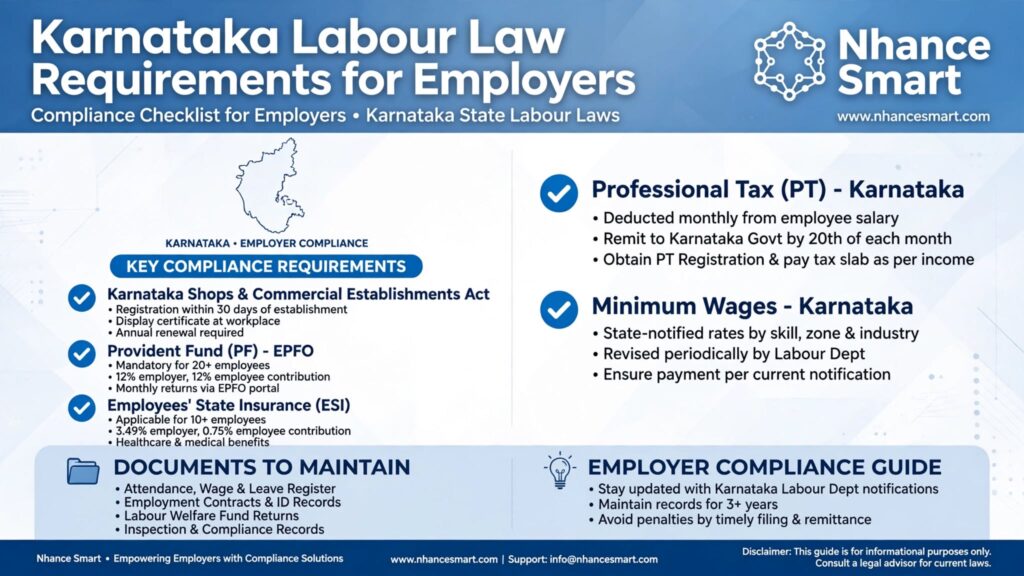
Managing employees involves more than hiring, salary processing and daily business operations. Every organisation must also follow applicable labour laws to protect employee rights and maintain legal compliance. For businesses operating in Karnataka, understanding the Karnataka labour law requirements for employers is essential to avoid compliance gaps, financial penalties and legal complications.
Whether you operate a startup, IT company, manufacturing unit, retail business or commercial establishment in Bangalore, Mysore, Mangalore or another part of Karnataka, you must identify the labour laws applicable to your business.
India’s labour law framework has also undergone significant changes with the implementation of the four Labour Codes from 21 November 2025. Employers must therefore review their existing HR policies, payroll structures and compliance processes in line with applicable central and Karnataka requirements.
In this guide, we will explain the key labour law requirements for employers in Karnataka and how businesses can manage their statutory responsibilities more effectively.
1. Understand the Applicable Labour Laws in Karnataka
Employers in Karnataka must comply with central labour legislation, state-specific requirements and rules applicable to their establishment and workforce.
The main areas of labour law compliance include:
- Establishment registration and licensing
- Employee wages and salary payments
- Provident Fund and social security
- Employee State Insurance
- Professional Tax
- Labour Welfare Fund
- Working hours and leave management
- Workplace health and safety
- Employee benefits and statutory records
- Contract labour and contractor compliance
The exact requirements depend on the organisation’s industry, employee strength, nature of work, location and applicable legal thresholds.
2. Registration Under the Karnataka Shops and Commercial Establishments Law
Businesses operating as shops, offices and commercial establishments must examine their registration and compliance obligations under the Karnataka Shops and Commercial Establishments Act and the applicable amendments.
This may apply to:
- IT and software companies
- Corporate offices
- Retail stores and showrooms
- Consulting businesses
- Commercial service providers
- Other covered establishments
Employers should maintain relevant establishment details, employee records and prescribed information. They should also review applicable requirements relating to working hours, weekly holidays, leave and employment conditions.
Important update: The Karnataka Shops and Commercial Establishments (Amendment) Act, 2026 came into force on 4 September 2026. It introduced changes relating to the applicability of the Act and the validity of registration certificates. Employers should check the amended provisions and current Labour Department guidance before applying for registration or renewal.
3. Provident Fund Compliance for Employees
Provident Fund is an important part of employee social security. Employers covered by the applicable provisions must register with the relevant authority, enrol eligible employees and deposit the required contributions.
Key employer responsibilities include:
- Completing applicable PF registration requirements
- Identifying employees eligible for PF coverage
- Calculating employee and employer contributions correctly
- Maintaining accurate employee and wage information
- Depositing contributions within the prescribed timelines
- Filing applicable electronic returns and maintaining records
- Supporting employees with PF-related documentation
PF applicability and contribution calculations must be reviewed under the current Code on Social Security framework and applicable schemes.
Employers should not rely only on outdated salary structures or historical contribution assumptions. They should verify the latest wage definitions, coverage rules and official notifications before processing payroll.
4. Employee State Insurance Compliance
Employee State Insurance provides eligible employees with medical and social security benefits under the applicable framework.
Employers must assess whether their establishment and employees fall within the coverage requirements.
Important responsibilities include:
- Obtaining applicable ESI registration
- Identifying eligible employees
- Completing employee insurance registration
- Calculating contributions correctly
- Depositing contributions within the prescribed timelines
- Maintaining employee and wage records
- Supporting employees with insurance-related requirements
ESI compliance should be reviewed whenever employee strength, salary structures or establishment details change.
5. Professional Tax Compliance in Karnataka
Professional Tax is a state-level tax that employers must consider while processing salaries in Karnataka.
Employers should:
- Obtain applicable Professional Tax registration
- Identify employees liable for Professional Tax
- Deduct the correct amount from eligible salaries
- Deposit the collected tax within the prescribed timelines
- File applicable returns
- Maintain deduction and payment records
The applicable tax amount and payment schedule should be verified against the latest Karnataka Government notifications.
Accurate payroll calculations are important because incorrect deductions or delayed payments can create compliance issues.
6. Karnataka Labour Welfare Fund Compliance
The Karnataka Labour Welfare Fund supports employee welfare activities and benefits.
Employers covered under the applicable provisions must calculate and deposit the required contributions and maintain supporting records.
Important 2026 update: The Karnataka Labour Welfare Fund (Amendment) Act, 2025, notified on 7 January 2026, expanded the applicability of the Act to covered establishments employing 10 or more persons, replacing the earlier threshold of more than 50 persons. The amendment also permits specified online payment methods.
Businesses that previously considered themselves outside the applicability of the Labour Welfare Fund should reassess their position under the amended law.
7. Minimum Wages and Salary Payment Requirements
Employers must ensure that employees receive wages in accordance with applicable minimum wage requirements and the relevant wage legislation.
Minimum wages can vary depending on:
- Type of industry or scheduled employment
- Employee category and skill level
- Geographical zone or location
- Applicable wage notifications
- Relevant revisions and variable dearness allowance
Employers should regularly review wage notifications issued by the Karnataka Government and check whether their salary structures meet the applicable requirements.
They should also ensure timely salary payments, accurate wage calculations and proper maintenance of payroll records.
8. Working Hours, Weekly Holidays and Leave Management
Employers must follow applicable provisions relating to working hours, rest intervals, weekly holidays and employee leave.
For covered establishments, HR teams should maintain clear policies and records for:
- Daily and weekly working hours
- Rest intervals
- Weekly holidays
- Overtime work and payments
- Annual and other applicable leave
- Attendance and shift management
- National and festival holidays, where applicable
Working-hour and overtime requirements may differ based on the establishment category and applicable legal framework.
Businesses should review their attendance policies and ensure that employee working hours are properly recorded.
9. Workplace Health, Safety and Employee Welfare
Workplace safety is another important responsibility for employers. Businesses must identify and follow the applicable occupational safety, health and working conditions requirements.
Depending on the establishment and nature of operations, responsibilities may include:
- Providing a safe working environment
- Maintaining workplace hygiene and sanitation
- Providing required safety equipment
- Conducting safety training
- Maintaining accident and incident records
- Following applicable emergency procedures
- Meeting prescribed health and welfare requirements
Manufacturing units, factories, construction businesses and other higher-risk workplaces may have additional requirements.
Employers should regularly review workplace safety practices and ensure that employees receive the necessary information and protection.
10. POSH Compliance and Workplace Harassment Prevention
Employers must also address workplace sexual harassment prevention and complaint-handling requirements under the applicable POSH framework.
Businesses should focus on:
- Implementing a written POSH policy
- Creating awareness among employees
- Providing appropriate training
- Establishing the required Internal Committee where applicable
- Maintaining complaint and inquiry records
- Following the prescribed reporting requirements
A clear workplace policy helps employees understand their rights and provides organisations with a structured process for handling complaints.
11. Contract Labour and Contractor Compliance
Businesses hiring workers through contractors must assess their responsibilities under the applicable contract labour and occupational safety framework.
Employers should verify that contractors maintain the required registrations, licences and employee records.
Important compliance activities include:
- Checking contractor registration and licence requirements
- Reviewing wage payment records
- Verifying applicable PF and ESI compliance
- Maintaining contractor employee details
- Monitoring attendance and working hours
- Checking applicable safety arrangements
- Keeping agreements and supporting documents
Principal employers should not assume that appointing a contractor removes all their statutory responsibilities. Applicable obligations must be reviewed based on the nature of the contract and the relevant law.
12. Maintain Employee Records and Statutory Documents
Proper documentation is essential for effective labour law compliance.
Employers should maintain applicable records such as:
- Employee personal and employment details
- Appointment letters and employment agreements
- Attendance and leave records
- Salary and wage registers
- PF and ESI contribution records
- Professional Tax deduction records
- Labour Welfare Fund payment details
- Overtime records
- Contractor and vendor documents
- Applicable statutory returns and licences
Maintaining accurate and updated records makes it easier to respond to inspections, internal audits and compliance verification.
13. Common Labour Law Compliance Challenges for Employers
Even organisations with dedicated HR teams can face difficulties managing statutory compliance.
Some common challenges include:
Frequent regulatory updates: Employers may find it difficult to track changes in central and Karnataka labour laws.
Incorrect payroll calculations: Errors in wages, statutory deductions or employee contributions can create compliance gaps.
Missed filing deadlines: Managing multiple payment dates and statutory returns manually increases the risk of delays.
Incomplete documentation: Missing employee records, registers or contractor documents can create problems during audits.
Multi-location compliance: Businesses operating across different states must manage varying state-specific requirements.
Contractor-related risks: Employers may face difficulties verifying whether contractors are meeting their statutory obligations.
A structured compliance process can help businesses reduce these risks and maintain better control over their responsibilities.
14. How NhanceSmart Helps Businesses Manage Labour Law Compliance
Managing labour law requirements manually can become difficult as an organisation grows. NhanceSmart helps businesses improve their compliance processes through technology-enabled solutions and professional support.
Its compliance ecosystem includes Complysmart, an AI-powered labour law compliance platform designed to help organisations manage regulatory requirements.
With Complysmart, businesses can work towards:
- Tracking applicable labour law requirements
- Monitoring regulatory updates
- Managing compliance calendars and important deadlines
- Identifying potential compliance gaps
- Organising statutory documentation
- Improving compliance visibility through dashboards
- Monitoring compliance activities across locations
NhanceSmart also offers Attendenz, a workforce management solution that supports employee-related processes such as attendance and workforce administration.
By combining compliance technology with structured HR processes, businesses can improve visibility, reduce manual work and manage their statutory responsibilities more efficiently.
To explore the available solutions, visit the NhanceSmart website and learn more about Complysmart.
15. Labour Law Compliance Checklist for Karnataka Employers
Employers can use the following checklist as a starting point for reviewing their compliance status:
- Review applicable establishment registrations and licences.
- Check current labour law applicability based on employee strength and business activities.
- Verify PF and ESI coverage and contribution requirements.
- Review Professional Tax registration, deductions and payments.
- Assess Karnataka Labour Welfare Fund applicability.
- Verify minimum wage rates and salary structures.
- Maintain attendance, leave and overtime records.
- Review working hours and weekly holiday arrangements.
- Maintain employee appointment and payroll documents.
- Check contractor registrations and statutory records.
- Review workplace safety and POSH requirements.
- Track statutory payment and return deadlines.
- Conduct periodic internal compliance audits.
- Monitor new central and Karnataka Government notifications.
This checklist should be customised according to the organisation’s industry, workforce and applicable legal requirements.
Conclusion
Understanding the Karnataka labour law requirements for employers is essential for businesses that want to maintain legal compliance and create a responsible workplace. From establishment registration and payroll management to PF, ESI, Professional Tax, Labour Welfare Fund and employee welfare, employers must review several statutory responsibilities.
With labour law changes and regulatory updates, businesses should regularly assess their compliance position instead of depending on outdated processes.
NhanceSmart helps organisations improve their compliance management through technology-enabled solutions such as Complysmart and Attendenz. By adopting a structured approach, businesses can improve compliance visibility, organise documentation and manage workforce-related responsibilities more effectively.