Payroll Compliance for Small Businesses in Bangalore – A Complete Guide for Employers
Managing employee salaries is an important responsibility for every business. However, payroll management involves much more than calculating monthly salaries and transferring payments to employee bank accounts. Businesses must also follow applicable labour laws, statutory deductions, tax regulations, and employee welfare requirements.
For small businesses and startups in Bangalore, managing these responsibilities can become challenging without a dedicated HR or payroll team. Incorrect salary calculations, missed PF and ESI contributions, Professional Tax deductions, or delayed statutory filings can result in penalties, compliance notices, and employee dissatisfaction.
This is why maintaining proper Payroll Compliance for Small Businesses in Bangalore is essential for organizations that want to operate smoothly and grow without unnecessary regulatory risks.
At NhanceSmart, we help businesses simplify payroll operations through professional payroll management, labour law advisory, and AI-powered compliance solutions. Our platforms, Complysmart and Attendenz, support organizations in managing regulatory requirements and improving workforce governance.
Why Payroll Compliance Is Important for Small Businesses
Many small businesses initially manage payroll using spreadsheets or basic accounting systems. While this approach may work with a limited workforce, payroll responsibilities become more complicated as the organization grows.
Businesses must understand applicable statutory requirements, maintain accurate employee records, calculate deductions, and complete payments within prescribed timelines.
Here are some important reasons why payroll compliance should be a priority.
Avoid Penalties and Legal Complications
Incorrect payroll calculations, delayed statutory payments, and missed compliance requirements can expose businesses to interest, penalties, and legal notices.
Following a structured payroll compliance process helps employers identify errors and reduce unnecessary financial risks.
Ensure Accurate Salary Processing
Employees expect to receive their salaries correctly and on time. Payroll compliance helps businesses maintain accurate salary calculations, deductions, reimbursements, overtime payments, and final settlements.
Maintain Employee Trust
Transparent payslips, correct statutory deductions, timely payments, and proper employee documentation help build confidence among employees.
Reduce HR and Administrative Workload
Small businesses often have limited HR resources. Managing payroll manually can consume valuable time that could otherwise be spent on recruitment, employee engagement, and business development.
Support Business Growth
As your employee strength increases, payroll and statutory responsibilities also become more complex. A professional payroll compliance system helps businesses establish organized processes that can support future expansion.
Essential Payroll Compliance Requirements for Small Businesses in Bangalore
Payroll compliance requirements depend on employee strength, salary structure, establishment category, and applicable central and Karnataka state legislation.
Small businesses should regularly review the following important compliance areas.
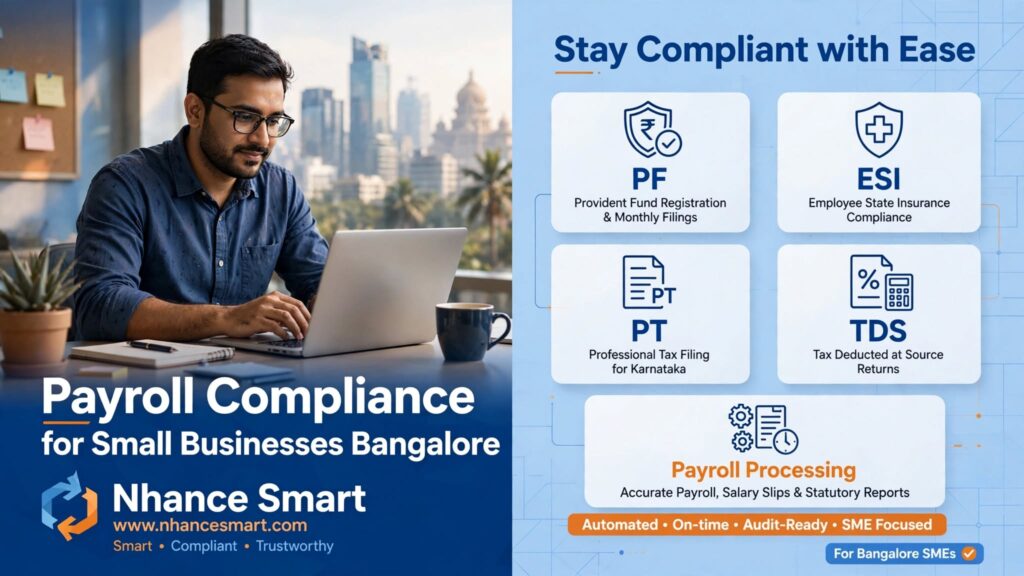
1. Provident Fund (PF) Compliance
Employee Provident Fund is an important social security benefit for eligible employees working in covered establishments.
Employers must understand applicable registration and contribution requirements and ensure that statutory responsibilities are completed correctly.
Important PF compliance activities include:
- Check whether the establishment is covered under applicable PF legislation.
- Complete PF registration wherever required.
- Maintain employee UAN and KYC details.
- Calculate applicable employee and employer contributions.
- Deposit monthly PF contributions within the prescribed timeline.
- File the applicable Electronic Challan-cum-Return (ECR).
- Maintain employee contribution and payment records.
- Review payroll information against PF records.
Proper PF compliance helps businesses maintain employee social security obligations and avoid contribution-related complications.
2. Employee State Insurance (ESI) Compliance
ESI provides eligible employees with medical and social security benefits under the applicable legislation.
Covered establishments must ensure that employee eligibility, contribution calculations, and statutory payments are managed properly.
Important ESI compliance activities include:
- Verify whether ESI registration is applicable.
- Register eligible employees.
- Maintain employee insurance information.
- Calculate employer and employee contributions.
- Deposit applicable contributions within prescribed deadlines.
- Maintain ESI payment challans and records.
- Update employee details whenever necessary.
- Review applicable accident reporting requirements.
Regular ESI monitoring helps businesses maintain statutory compliance and support employee welfare.
3. Professional Tax Compliance in Karnataka
Professional Tax is an important payroll responsibility for eligible employers operating in Karnataka.
Businesses must understand the applicable registration, employee salary thresholds, deductions, payment schedules, and filing requirements.
Important Professional Tax activities include:
- Obtain applicable Professional Tax registration.
- Review employee salary information.
- Identify employees liable for Professional Tax.
- Calculate deductions according to current Karnataka tax slabs.
- Deduct applicable tax from employee salaries.
- Deposit collected tax within prescribed timelines.
- File applicable Professional Tax returns.
- Maintain payment challans and statutory records.
Businesses should regularly verify Karnataka Professional Tax notifications to ensure accurate deductions and payments.
4. Tax Deducted at Source (TDS) on Salary
Employers must review salary-related TDS obligations under the applicable income tax provisions.
Accurate tax calculations and timely deductions are important for maintaining payroll compliance.
Important TDS activities include:
- Obtain a Tax Deduction and Collection Account Number (TAN), wherever required.
- Collect employee tax declarations.
- Review employee salary structures.
- Calculate applicable taxable income.
- Apply eligible deductions and exemptions according to current tax provisions.
- Deduct salary TDS wherever applicable.
- Deposit deducted tax within prescribed timelines.
- File applicable quarterly TDS returns.
- Issue the relevant salary TDS certificates.
Accurate TDS management helps employees maintain proper tax records and reduces employer compliance risks.
5. Minimum Wages and Salary Compliance
Employers must ensure that employees receive wages according to applicable minimum wage notifications.
Minimum wages may differ depending on the industry, employee category, skill level, and geographical classification.
Important payroll activities include:
- Identify applicable minimum wage requirements.
- Review employee job categories and skill classifications.
- Maintain compliant salary structures.
- Verify basic wages and applicable allowances.
- Calculate overtime payments correctly.
- Maintain accurate wage registers.
- Ensure timely salary payments.
- Update payroll structures when applicable wage notifications change.
Following applicable wage requirements helps businesses avoid salary-related disputes and statutory complications.
6. Labour Welfare Fund Compliance
Businesses covered under Karnataka Labour Welfare Fund provisions must understand their applicable employee and employer contribution responsibilities.
Important activities include:
- Check whether the establishment is covered.
- Identify employees covered under applicable provisions.
- Calculate required employee and employer contributions.
- Complete payments within prescribed timelines.
- Maintain contribution records.
- Review annual compliance requirements.
Small businesses should not assume that Labour Welfare Fund obligations apply only to large organizations. Applicability must be checked against the current statutory requirements.
7. Bonus and Gratuity Compliance
Employee benefits form another important part of payroll and statutory compliance.
Depending on applicable coverage and employee eligibility, businesses may have responsibilities relating to bonus and gratuity payments.
Important activities include:
- Identify employees eligible for statutory bonus.
- Calculate applicable bonus payments.
- Maintain bonus calculation records.
- Review gratuity eligibility.
- Maintain employee service records.
- Calculate eligible gratuity payments.
- Process final settlements according to applicable requirements.
Proper employee benefit management helps businesses maintain transparent payroll practices.
Monthly Payroll Compliance Checklist for Small Businesses
Small businesses should follow a regular payroll compliance schedule to avoid missed payments and filing deadlines.
The following checklist covers important activities that employers should review.
Before Processing Monthly Payroll
- Collect employee attendance details.
- Review leave and overtime records.
- Update new employee information.
- Check employee salary revisions.
- Verify reimbursements and incentives.
- Review employee joining and exit details.
- Confirm applicable statutory deductions.
During Payroll Processing
- Calculate employee gross salaries.
- Apply applicable salary deductions.
- Calculate PF contributions wherever applicable.
- Calculate ESI contributions wherever applicable.
- Deduct applicable Professional Tax.
- Calculate salary TDS where required.
- Review overtime and additional payments.
- Prepare accurate salary statements.
After Payroll Processing
- Transfer salaries to employee bank accounts.
- Generate employee payslips.
- Deposit applicable statutory contributions.
- Complete required statutory filings.
- Reconcile payroll and accounting records.
- Maintain payment challans.
- Update employee payroll documentation.
Following this process every month helps businesses maintain better control over payroll operations.
Common Payroll Compliance Mistakes Small Businesses Should Avoid
Many small businesses face payroll-related problems because they do not have dedicated compliance professionals or established payroll procedures.
Some common mistakes include:
Incorrect Salary Calculations
Errors in basic salary, allowances, deductions, overtime, and reimbursements can result in incorrect employee payments.
Missing PF and ESI Contributions
Not checking employee eligibility or missing applicable contribution deadlines can create compliance liabilities.
Incorrect Professional Tax Deductions
Using outdated salary thresholds or incorrect Karnataka tax slabs can lead to payroll errors.
Delayed TDS Payments
Missing applicable TDS deposit or return filing deadlines can result in interest and additional liabilities.
Poor Employee Documentation
Missing appointment letters, employee records, salary statements, and statutory documents can create problems during audits and inspections.
Using Outdated Payroll Systems
Manual spreadsheets and outdated payroll processes can increase the possibility of calculation errors and missed statutory updates.
Ignoring Changes in Labour Regulations
Businesses must regularly review applicable labour laws, wage notifications, and statutory requirements to ensure their payroll processes remain compliant.
How NhanceSmart Helps Small Businesses Manage Payroll Compliance in Bangalore
At NhanceSmart, we understand that small businesses need reliable payroll and compliance support without creating unnecessary administrative complexity.
Our specialists combine practical labour law knowledge with modern technology to help organizations manage payroll responsibilities efficiently.
End-to-End Payroll Management
We help businesses streamline important payroll activities, including:
- Monthly salary processing.
- Employee salary calculations.
- Payroll deductions and adjustments.
- Payslip preparation.
- Employee reimbursement management.
- Payroll reports.
- Full and final settlement support.
- Statutory payroll documentation.
Complete Payroll Statutory Compliance
Our compliance professionals support businesses with applicable statutory requirements, including:
- PF Compliance.
- ESI Compliance.
- Professional Tax Compliance.
- Salary TDS Compliance.
- Labour Welfare Fund Compliance.
- Minimum Wages Compliance.
- Bonus and Gratuity Compliance.
- Labour Law Documentation.
- Statutory Compliance Audits.
Expert Labour Law Advisory
Payroll and labour law compliance are closely connected.
Our specialists help businesses understand applicable regulations, employee-related statutory responsibilities, registration requirements, and important compliance obligations.
This helps organizations maintain more organized payroll and HR operations.
AI-Powered Compliance Support with Complysmart
Complysmart is NhanceSmart’s AI-powered compliance platform designed to help businesses improve regulatory intelligence and compliance visibility.
It supports organizations in tracking relevant regulatory requirements and managing compliance responsibilities more effectively.
Workforce Governance with Attendenz
Attendenz supports hire-to-retire workforce governance and helps organizations manage employee-related processes.
By connecting workforce management with compliance requirements, businesses can improve operational visibility and maintain better control over employee-related activities.
Customized Solutions for Startups and SMEs
Every small business has different payroll requirements.
NhanceSmart helps organizations understand their workforce structure, employee strength, payroll processes, and applicable statutory obligations before recommending suitable solutions.
Why Small Businesses Should Choose Professional Payroll Compliance Services
Managing payroll internally may seem simple when a business has only a few employees. However, as the workforce grows, statutory responsibilities and administrative requirements also increase.
Professional payroll compliance support offers several benefits:
- Accurate salary processing.
- Better statutory compliance management.
- Reduced payroll calculation errors.
- Timely statutory payments and filings.
- Proper employee documentation.
- Improved payroll transparency.
- Reduced administrative workload.
- Better employee satisfaction.
- Professional labour law guidance.
- Scalable payroll solutions for growing businesses.
For startups and SMEs, outsourcing payroll compliance can help reduce operational pressure while improving payroll accuracy and regulatory management.
How to Choose the Right Payroll Compliance Partner in Bangalore
Choosing the right payroll partner is an important business decision.
Before selecting a service provider, consider the following factors.
Experience in Payroll and Labour Laws
Choose a provider with practical experience in Indian payroll regulations and statutory compliance.
Complete Payroll Services
Your payroll partner should understand salary processing, statutory deductions, employee documentation, and applicable filing requirements.
Knowledge of Karnataka Regulations
Professional Tax, Labour Welfare Fund, and other state-specific requirements should be managed according to applicable Karnataka regulations.
Technology-Driven Solutions
Digital compliance monitoring, organized payroll reports, and secure employee information management can improve operational efficiency.
Customized Business Support
Choose a provider who understands your employee strength, business activities, and compliance responsibilities.
Ongoing Compliance Assistance
Payroll compliance is a continuous responsibility. Your service provider should offer regular support rather than only handling initial registration or setup.
Conclusion
Payroll compliance is an essential responsibility for every small business operating in Bangalore. From salary processing and PF to ESI, Professional Tax, TDS, and employee benefits, businesses must manage applicable statutory obligations carefully.
Maintaining proper Payroll Compliance for Small Businesses in Bangalore helps organizations reduce payroll errors, avoid unnecessary compliance risks, improve employee satisfaction, and establish reliable HR operations.
At NhanceSmart, we combine professional payroll expertise, labour law advisory, and AI-powered compliance technology to help startups, SMEs, and growing businesses simplify their payroll responsibilities.
Whether you are managing a small team or expanding your workforce, our customized payroll and HR compliance solutions are designed to support your business requirements.